SHRM CP Situational Questions Effective Answer Strategies
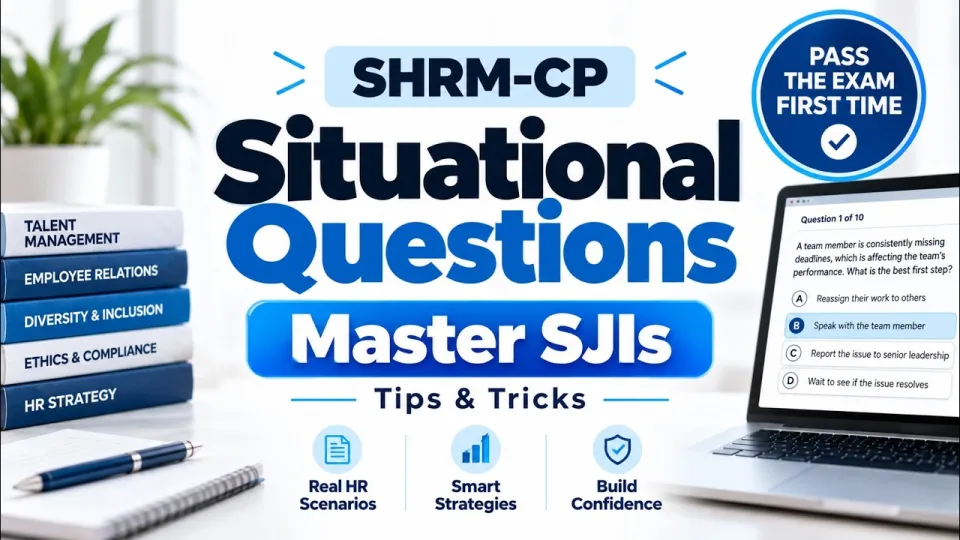
Video: SHRM CP Situational Questions (SJIs) | TIPS TO PICK THE RIGHT ANSWER
· based on the channel PrepSolution
SHRM CP Situational Questions require candidates to select the best answer from multiple seemingly reasonable options. Mastery of these questions hinges on understanding how to compare choices rigorously, recognize common answer traps, and apply a structured decision-making framework. This article provides essential strategies to excel at SHRM CP situational judgment items (SJIs) and improve your exam readiness.
Understanding SHRM CP Situational Questions
Situational Judgment Items in the SHRM CP exam simulate real HR workplace scenarios, asking you to choose the most appropriate response. The challenge is that multiple answers often appear correct at first glance. The key is discerning subtle differences in wording and context to identify the best choice aligned with SHRM standards.
Five Decision Checks for Picking the Right Answer
A reliable method to approach situational questions involves applying five decision checks to each answer option:
- Facts: Does the answer align with the specific details given in the scenario? Avoid assumptions beyond the facts.
- Policy and Law: Is the choice compliant with relevant laws and organizational policies?
- Appropriate Escalation: Does the action demonstrate proper escalation without unnecessary involvement of higher management?
- HR’s Role: Is the option consistent with HR’s responsibilities, avoiding overstepping into managerial duties?
- People Involved: Are the relevant stakeholders correctly considered and involved?
Using these checks helps eliminate answers that are legally defective, premature, passive, or improperly escalated.
First Step vs. Most Effective Action
A critical distinction is whether the question asks for the "first" step in a process or the "most effective" action overall. For example, when dealing with a workplace conflict, the first step might be gathering information or de-escalating tensions, while the most effective answer could involve mediation or formal discipline later in the process. Pay close attention to question wording to avoid common pitfalls.
Common Answer Traps to Avoid
SHRM CP situational questions often include distractors designed to test your judgment. Recognizing these traps improves accuracy:
- Premature Action: Acting before gathering sufficient information.
- Passive Responses: Avoiding necessary action or responsibility.
- Taking Over Manager’s Role: HR should support but not replace supervisors.
- Unnecessary Escalation: Involving higher authority without cause.
- Legally Defective Options: Choices that violate laws or policies.
By identifying these traps, you can confidently eliminate incorrect answers.
Practical Elimination Techniques
Instead of relying solely on how your own workplace handles situations, test each option against the scenario’s exact facts and instructions. Consider wording nuances such as "immediately," "next step," or "best approach." This practice prevents bias and aligns your answers with SHRM’s intended standards.
Example Scenario Walkthrough
Consider a situation where a supervisor wants to discipline an employee after a shouting match. The question asks how HR should respond. Applying the five decision checks:
- Fact check: What actually happened?
- Policy check: Is there a workplace violence or conflict policy?
- Escalation check: Should HR intervene directly or advise the manager?
- HR role: Facilitate the process, not take charge of discipline.
- People involved: Include supervisor, employee, and possibly higher management if warranted.
Comparing all four answer choices with these checks reveals the best option, avoiding traps like rushing to discipline without investigation or ignoring the conflict.
Helpful Links
Access free SHRM-CP practice questions and resources at PrepSolution SHRM-CP Free Practice.
Итог
Successfully navigating SHRM CP situational questions relies on structured decision-making using five key checks and awareness of common answer traps. Understanding the difference between the first step and the most effective action is crucial. Eliminate answers that conflict with facts, law, or HR’s role, and test options against the scenario, not personal experience. The detailed walkthroughs and tips from the PrepSolution channel provide practical, actionable strategies to boost your confidence and exam performance. For continued practice and preparation, visit PrepSolution’s free SHRM-CP practice site linked above.
Useful Resources
Key takeaways
- SHRM CP Situational Judgment Items (SJIs) test decision-making in HR scenarios
- Five decision checks guide the right answer: facts, policy, escalation, HR role, involved people
- Common traps include premature action, passive response, overstepping, escalation, legal faults
- Distinguish first step vs. most effective action in question wording
- Practical elimination based on scenario facts outperforms personal workplace bias
Source: SHRM CP Situational Questions (SJIs) | TIPS TO PICK THE RIGHT ANSWER · Markdown version
Questions & answers
What are SHRM CP Situational Judgment Items (SJIs)?
SHRM CP SJIs are exam questions presenting workplace scenarios where candidates must choose the best response among several reasonable options to demonstrate HR decision-making skills.
How can I differentiate between the first step and the most effective action in SHRM CP questions?
Carefully read the question to identify if it asks for the immediate next action (first step) or the overall best solution (most effective action), then select your answer accordingly.
What are common traps in SHRM CP situational questions?
Common traps include premature action, passive responses, taking over managerial duties, unnecessary escalation, and legally incorrect options—all designed to mislead if not carefully analyzed.
Where can I find free SHRM CP practice questions?
Free SHRM CP practice questions are available at PrepSolution’s website: https://prepsolution.com/free-practice/shrm-cp?utm_source=youtube&utm_medium=video&utm_campaign=shrmcp_longform&utm_content=cp_long_v09